Research Center — Published Field Documentation
African “Fingerprint” Ruby – Natural Unheated Corundum (Field Specimen)
Concise field and preliminary gemological record of a 95.60 ct corundum specimen. This record documents observations; it is not a laboratory certificate.
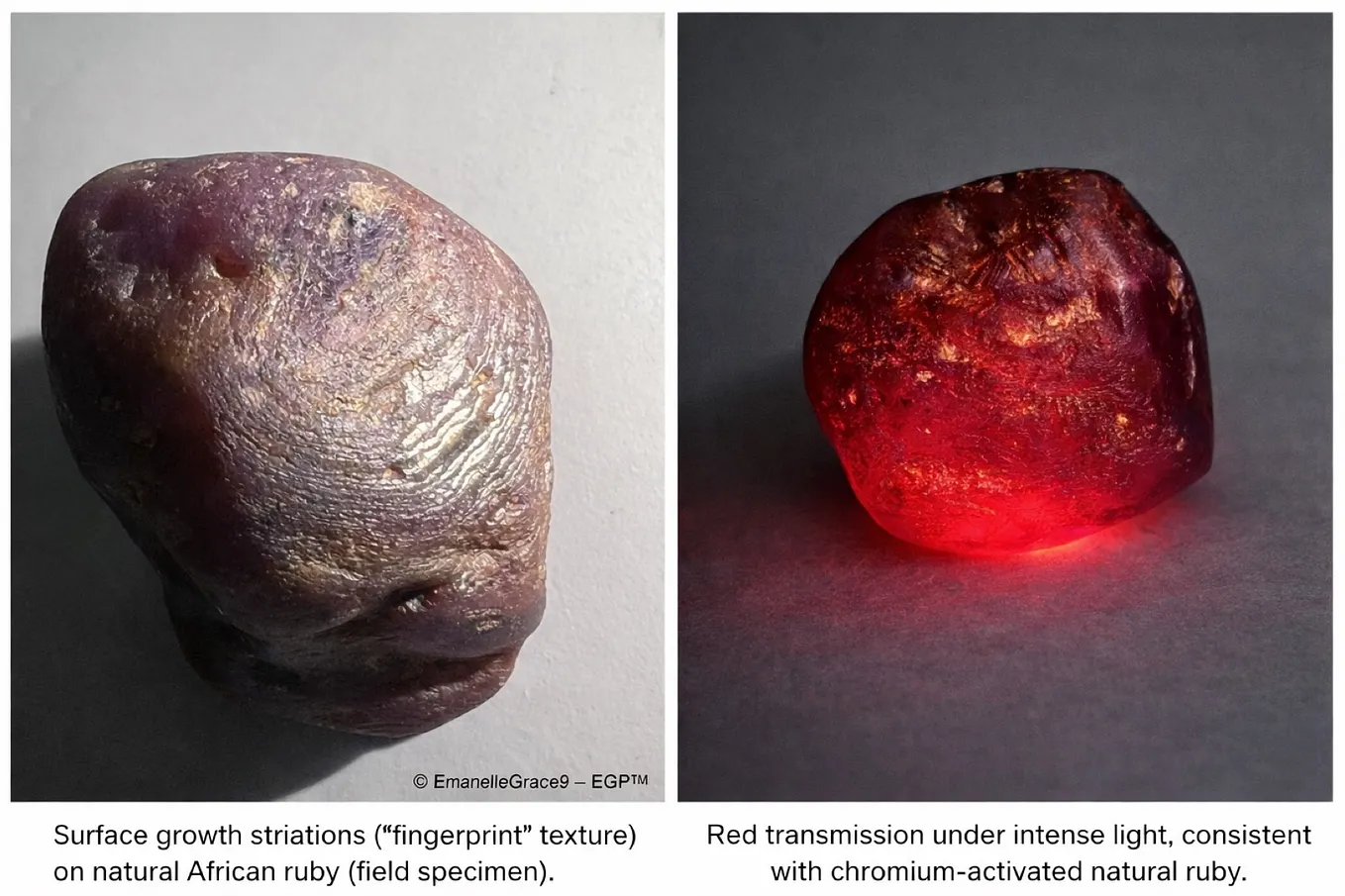
Field specimen as documented in the original record. Photography and documentation by Eman Galeb Hamza.
- Archive ID
- AFR-RBY-FP-20251021–1747
- Author / documentation
- Eman Galeb Hamza — EmanelleGrace9
- Series
- EGP Scientific Reference Series
- Original publication
- Medium — 12 January 2026
Source publication: Original Medium article — African “Fingerprint” Ruby
Specimen Record
- Scientific identification
- Corundum, ruby variety (Al₂O₃, chromium-related coloration)
- Weight
- 95.60 ct / 19.12 g
- Transparency
- Semi-translucent to moderately opaque
- Luster
- Vitreous to greasy
- Surface observation
- Pronounced natural growth striations, described visually as a “fingerprint” texture
- Reported field origin
- Mozambique / Tanzania — reported in the original field record; NOT independently confirmed and NOT a laboratory origin determination
- Response to intense light / UV
- Strong red response reported, consistent with chromium activation
- Preliminary microscopy
- Record mentions rutile silk / boehmite tube-like features and natural growth zoning
- Heat-related features
- None observed in the preliminary examination
Observation
A rough corundum specimen of 95.60 ct (19.12 g) presenting semi-translucent to moderately opaque diaphaneity and a vitreous to greasy luster. The surface carries pronounced natural growth striations forming a dense, ridge-like pattern described visually as a “fingerprint” texture. Under intense light and ultraviolet illumination, a strong red response was reported. Preliminary microscopy notes silk-like and tube-like internal features together with natural growth zoning. No heat-related features were observed during this preliminary examination.
Interpretation
The observed red response is consistent with chromium activation in corundum. The silk-like and tube-like features recorded are consistent with descriptions of rutile and boehmite in natural corundum, and the growth zoning is consistent with natural growth. These observations are suggestive rather than diagnostic: none of them, individually or combined, establishes species confirmation beyond the field level, thermal history, or geographic origin. The origin reported in the original field record (Mozambique / Tanzania) reflects supply-chain information and is not independently confirmed.
Conclusion and required confirmation
The specimen is documented as corundum of the ruby variety at field and preliminary examination level. Refractive index measurement and advanced analytical testing such as FTIR and/or Raman spectroscopy may be required before any definitive statement on thermal history, treatment, or geographic origin. Definitive documentation should be obtained from an independent qualified gemological laboratory.